 Chickie Wah Wah
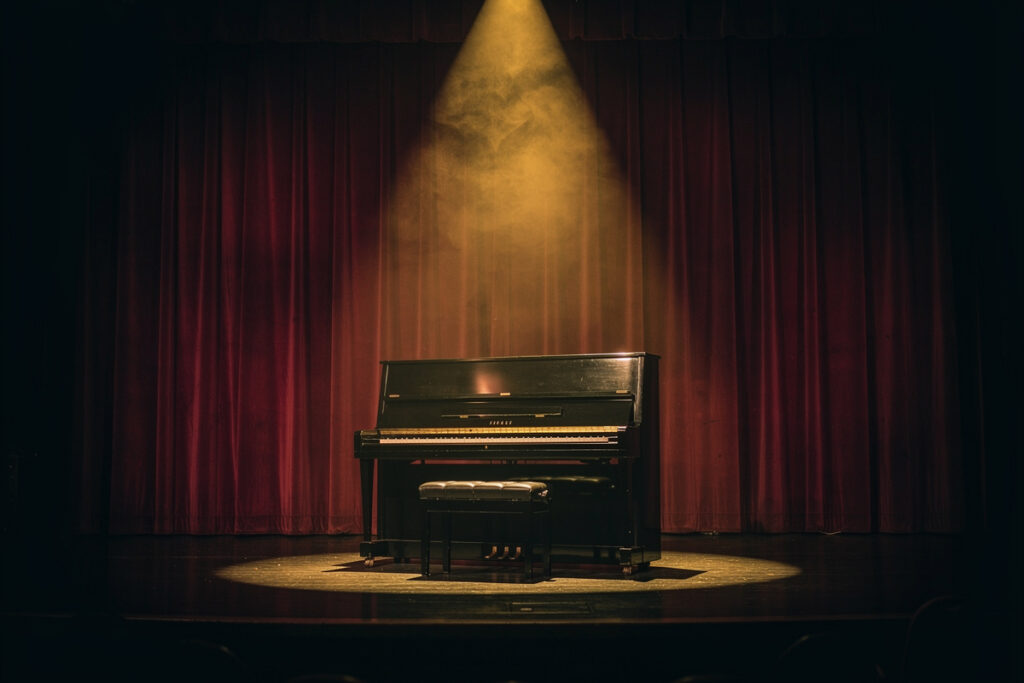
If you want to understand what a listening room is actually for, watch a great piano player work one. Jon Cleary — widely considered one of the finest pianists New Orleans has produced — has long made Chickie Wah Wah a regular home, and the pairing tells you as much about the room as it does about the player. This is the first in an ongoing series of artist spotlights, and there’s no better place to start.
Jon Cleary, widely considered one of New Orleans’ finest pianists, holds a long-running residency at Chickie Wah Wah, a roughly 200-seat listening room on Canal Street built so the quiet gives his playing room to breathe.
Why a Pianist Needs a Room Like This
A piano is a quiet instrument until it isn’t. Its entire range — the barely-touched left-hand figure, the sudden two-fisted turnaround, the single held note left ringing in the air — only lands if the room is paying attention. In a loud bar, half of what a player like Cleary does simply vanishes into the noise. The subtle stuff, which is usually the best stuff, never reaches the back of the room. In a listening room, all of it survives.
That’s the entire premise of Chickie Wah Wah, and it’s why the best players in the city keep coming back to a roughly 200-seat room on Canal Street when they could play larger, louder rooms elsewhere. The trade — fewer seats, more listening — is one that serious musicians make gladly, because it lets them play the full instrument instead of just the parts that can punch through a crowd. A great pianist in a quiet room is one of the genuine pleasures New Orleans offers, and it’s increasingly rare.
There’s a feedback loop to it, too. When the audience is quiet and locked in, the player takes more chances — stretches a solo, tries the unexpected voicing, follows a tangent to see where it goes. A great night of piano is a conversation between the stage and the room, and it only happens when the room holds up its end. This room does.
A Regular Home
Cleary’s connection to Chickie Wah Wah is not a one-off booking; it’s a residency in the truest sense — a player who returns often enough that the room becomes part of his sound and he becomes part of the room’s identity. Regulars learn to watch for his nights. Newcomers who happen to catch one tend to become regulars. That’s how a residency works: it builds an audience that belongs to the room and the artist together.
It also changes what a night can be. When a great player treats a room as home rather than a tour stop, the shows get loose in the best way — the guest sit-ins, the deep cuts, the sense that anything might happen because the artist is comfortable enough to let it. You can’t manufacture that. It only comes from a real, repeated relationship between a musician and a room.
There’s one story that captures the whole thing. The night before his 2019 Jazz Fest performance, Tom Jones — yes, that Tom Jones — turned up at Chickie Wah Wah unannounced and sang alongside Jon Cleary. No stadium, no announcement, just a legend walking into a Mid-City listening room because that’s where the music was that night. It’s the kind of moment that only happens in a room built to be heard, around a residency that makes the room feel like an artist’s living room.
The best players in New Orleans keep choosing a small room on Canal Street. That’s not an accident. It’s the point.
See Him Here — The Artist Hub
Every Jon Cleary appearance at Chickie Wah Wah — past and upcoming — lives on his artist hub page. That’s the page to bookmark if he’s the reason you’re coming. It keeps a running, chronological list of his dates here, each linking straight through to the details and tickets for that specific night, so following an artist is as easy as following a calendar.
The hub pages are a new thing we’ve built for exactly this reason. An individual event page is focused on one night — the date, the door time, the ticket. But an artist is bigger than any single show, and the hub is where an artist’s whole relationship with this room lives in one place. Discover a player on a random Tuesday, find their hub, and you’ll never miss their next date.
What a Piano Night in This Room Feels Like
If you’ve never spent an evening watching a great player work a genuinely quiet room, here’s what to expect — not the setlist, which changes, but the shape of the night. You’ll notice the quiet first. Between songs, and often within them, the room actually goes still, and that stillness is doing work: it’s the blank canvas the next phrase gets painted on. A soft passage that would vanish in a bar arrives here at full resolution.
You’ll notice the closeness next. Around 200 seats means there is no bad spot and no real distance between the stage and the floor. You can watch the hands. You can hear the pedal. You catch the small stuff — a muttered aside, a count-in, the little laugh when something almost goes wrong and doesn’t. That intimacy is not a gimmick; it’s the entire product.
And you’ll notice, if you stay for the whole set, that the show tends to open up as it goes. A player who feels the room listening relaxes into it and starts to take chances. The back half of a night in a room like this is often where the magic is — which is a good argument for getting there at doors and staying to the end rather than treating it like a bar you drift in and out of.
The other thing worth saying is that one great night tends to lead to more. Regulars don’t come back to Chickie Wah Wah out of habit; they come back because a residency rewards return visits in a way a one-off show can’t. You start to recognize the material, notice how a player reworks a song from one night to the next, and pick up the running thread that only exists if you keep showing up. A single show is a snapshot. A residency is a story you can follow — and following it is exactly what the artist hub is built to make easy.
A Note on This Spotlight
We’ve kept this piece to what we can stand behind — the residency, the room, and the verified history of this stage. Jon Cleary’s full biography, his recordings, and his life beyond this room are his own story to tell, and we’re not going to pad a tribute with details we haven’t confirmed. When we build out deeper artist profiles, they’ll rest on verified facts, not filler. For now, the surest way to know Jon Cleary is the same as it’s always been in New Orleans: catch him at Chickie Wah Wah, and let the playing introduce itself. The rest of the room’s story, and the philosophy behind it, is on our About page, and the shows themselves are always on the calendar. If this is your first artist spotlight, it won’t be your last — there are plenty more players who’ve made this room home, and each one is worth the trip.