 Chickie Wah Wah
Most music venues are named after a street, a founder, or a feeling. Chickie Wah Wah is named after a song — and, more precisely, after two of them, cut two years apart by two of the most original figures in New Orleans rhythm and blues. It is a name that most people can’t place and never forget, which turns out to be exactly the right quality for a room that trades in music the rest of the country tends to overlook.
Chickie Wah Wah is named after two 1956–1958 R&B singles — Bobby Marchan’s original “Chickie Wah Wah” and Huey “Piano” Smith’s answer record “Little Chickee Wah Wah” — the name founder Dale Triguero chose when he opened the club in 2006.
The story starts in 1956, when Bobby Marchan recorded a single called “Chickie Wah Wah,” written by his bandleader, Huey “Piano” Smith. It is a small, strange, joyful record — the kind New Orleans produced by the crate in the 1950s and that the rest of the country spent the next decade catching up to. To understand why a music venue would name itself after it, you have to understand the two men involved.
Who Was Bobby Marchan?
Bobby Marchan was one of the most flamboyant and boundary-breaking performers the city ever produced. He was a founding voice alongside Huey Smith in the group that became The Clowns, and he was an out, gender-bending stage presence decades before the mainstream had any language for it. In a city that has never been short on characters, Marchan genuinely stood out — not as a novelty act, but as a real artist who happened to refuse every box anyone tried to put him in.
That refusal is a large part of why the name fits a listening room. Chickie Wah Wah was built for artists who do their own thing in front of an audience that actually wants to hear it — players who don’t sand down the odd corners of what they do to fit a room. Marchan is the patron saint of exactly that. Naming a venue after his record is a way of saying, before a single note is played, what kind of place this intends to be.
It also quietly makes a point about who New Orleans music history belongs to. The famous names get the statues and the street signs. The Bobby Marchans — essential, influential, and never quite as celebrated as they should have been — get remembered by the people who were paying attention. Putting his song over the door is a small correction to that record.
Huey “Piano” Smith and the 1958 Answer
Two years after Marchan’s single, in 1958, Huey Smith — the man who wrote the original — released his own version, “Little Chickee Wah Wah,” on Vin Records. Smith is one of those figures whose fingerprints are all over American popular music even if his name never got as large as it should have. His piano playing and his songwriting helped shape the New Orleans sound that fed directly into rock and roll; a lot of what the wider world later called rock started as a piano figure in a New Orleans studio.
So the name carries two records, not one: the singer’s version and the writer’s version, the performance and the composition. That distinction matters more than it might seem. A song in New Orleans is rarely a fixed object — it’s a thing that gets passed around, reinterpreted, answered, and reinvented by whoever picks it up next. “Chickie Wah Wah” being both a Marchan record and a Smith record is not a footnote; it’s the whole New Orleans idea of what a song is, compressed into one title.
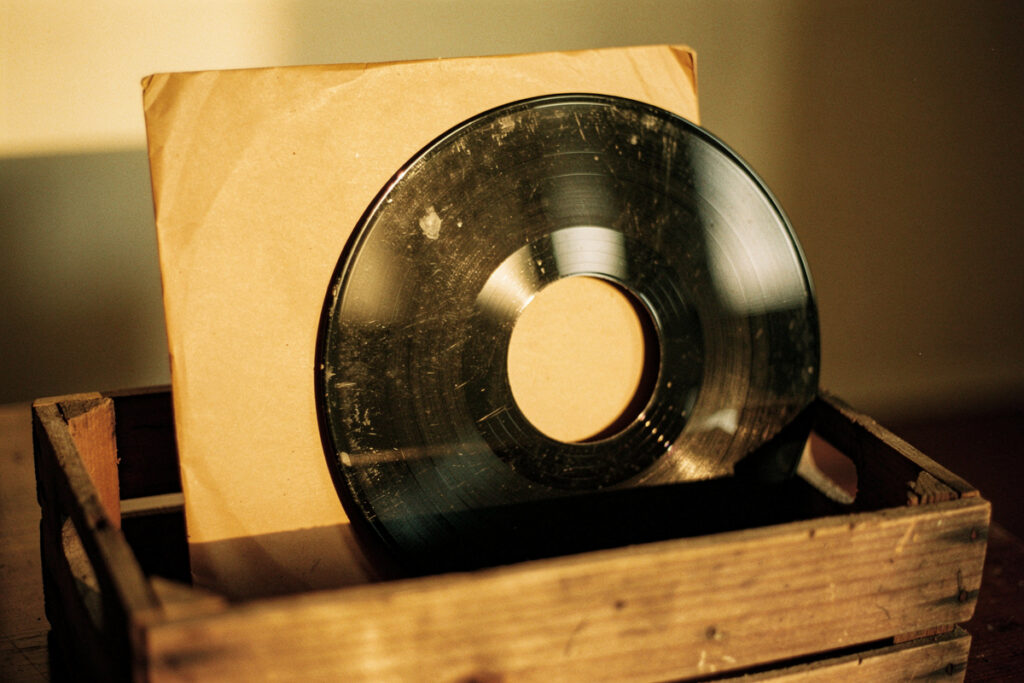
Both still hang on our walls, alongside painted portraits of the two men who made them. Walk in on any given night and you are, in a small way, standing inside a piece of New Orleans music history — not in a museum case, but in a working room where new music is being made a few feet away.
We think of Bobby and Huey as our patron saints. The name isn’t a marketing exercise — it’s a debt.
Why Dale Chose It in 2006
When Dale Triguero opened the club in 2006, in the former Canal Bus Stop building on Canal Street, he could have named it anything. The safe move for a new music room is a name that tells you what you’re getting — something with “blues” or “jazz” or the neighborhood in it. Dale instead chose a nearly-forgotten 1956 R&B single that most passersby would have to ask about.
That was the point. The name is a deliberate act of preservation — a way of keeping two names alive by putting them over the door of a room where live music happens seven nights a week. Every time someone asks “what does Chickie Wah Wah mean?”, the answer brings Bobby Marchan and Huey Smith back into the conversation. A record that could have slipped out of memory instead gets explained, over and over, to a new set of listeners.
You can read the fuller arc of the room’s history — from Hurricane Katrina to the community that eventually saved it — on our About page. It’s of a piece with the name: a story about refusing to let good things in New Orleans quietly disappear.
A Living Wall, Not a Museum
It matters that the two records and the two portraits hang in a working music room rather than behind glass somewhere. A museum preserves the past by separating it from the present — you look, you read the little card, you move on. A listening room preserves it by keeping it in use. The Marchan and Smith records aren’t relics at Chickie Wah Wah; they’re context. They hang over a stage where new songs are being written into the same tradition, night after night.
That’s a very New Orleans way to handle history. This is a city that keeps its dead present, that plays music at funerals and treats old songs as living material rather than settled artifacts. The name over the door does the same thing on a smaller scale: it takes two men who might have faded into a discography footnote and keeps them in the room, in the conversation, in the mouths of everyone who asks what the name means and gets told the story. The wall isn’t nostalgia. It’s a lineage, and the current lineup is the next line of it.
There’s a quiet responsibility in that, and the room takes it seriously. Naming yourself after someone else’s art means living up to it — booking players worth the association, treating the music as the point, keeping the standard where Bobby and Huey would have wanted it.
Two Singers, One Song, One Room
There is something fitting about a listening room named after an answer record. The whole idea of Chickie Wah Wah is that a song is worth paying attention to — worth a second version, a second listen, a room where nobody talks over the bridge. Marchan and Smith understood that in 1956 and 1958. We’re just keeping the volume up and the room quiet enough to hear what they heard.
If any of this makes you want to see the two records for yourself, they’re not hard to find — they’re on the wall, and the wall is in a room full of live music most nights of the week. Honor Bobby and Huey the way they’d probably prefer: come hear somebody play. Here’s who’s on the calendar, and if you’re not sure how to reach us, our streetcar guide makes it a fifteen-minute ride from the French Quarter. Find the records first. Then find a seat.